
The Beautiful Complexity of Being Human
On growing older, feeling connected, and the extraordinary things happening in ordinary moments.
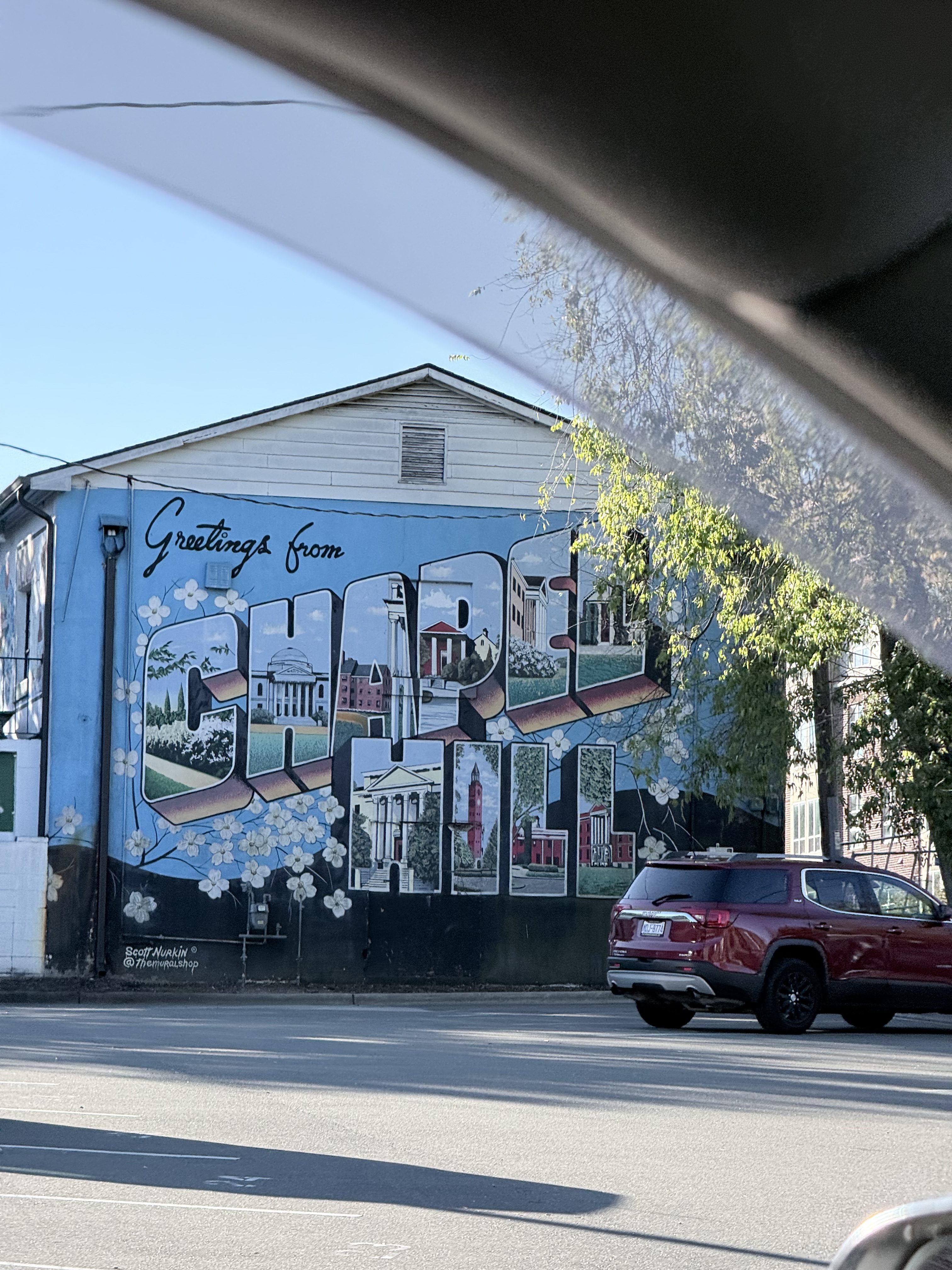
My husband and I were driving through Chapel Hill, North Carolina, today.
We lived here in our twenties. We had our first child here. We spent years navigating the peculiar combination of youthful ambition, financial uncertainty, and the terrifying realization that we were somehow expected to become functioning adults.
Coming back felt strangely familiar.
The same bustling sidewalks. The same public transit buses weaving through traffic. The same seemingly endless hordes of college students moving between classes, coffee shops, restaurants, and bars.
And then something occurred to me.
They’re all still the same age.
Not the same people, obviously, but the same collection of youthful faces, overflowing backpacks, and hurried footsteps. An entire population seemingly frozen in a particular chapter of life.
Meanwhile, I’ve aged ten years.
Ten years!
I looked out the window at the students passing by, their smooth faces and youthful energy standing in contrast to my own fine lines, slightly looser skin, and the subtle reminders that time has been marching along whether I’ve been paying attention or not.
You might think that realization would make me feel old. Disconnected. Like an outsider looking into a world I once belonged to.
But it didn’t.
Quite the opposite, actually.
I felt invigorated.
There was something intoxicating about the endless stream of life unfolding around me. Students laughing on sidewalks. Strangers sharing tables in crowded coffee shops. People rushing to appointments, lingering over lunch, arguing about something entirely insignificant, or perhaps having conversations that would change the trajectory of their lives.
Real life.
Happening in a thousand different ways, all at once, right in front of me.
And here’s the part I find fascinating.
Every single person occupying that same stretch of pavement was experiencing an entirely different version of the exact same moment.
One student might have been walking to an exam that would determine whether she could remain in her program. Another might have just fallen in love. Someone else might have been grieving a loss, celebrating a victory, or wondering how the hell they were going to afford groceries that week.
And there I was, sitting in a car, contemplating the passage of time and the elasticity of human experience.
We were all sharing the same physical space, yet inhabiting completely different realities.
Ask us about that afternoon ten years from now, and we’d tell wildly different stories.
Some would remember it vividly.
Others wouldn’t remember it at all.
An entire moment in time, experienced and then discarded because nothing happened that made it significant enough to keep.
Isn’t that extraordinary?
I think about things like this constantly.
Humans are fascinating creatures.
We communicate differently. We interpret information through our own experiences, biases, cultures, and beliefs. We build communities around shared interests, identities, circumstances, and geography.
And yet, despite all these differences, we have this remarkable capacity to connect.
Sometimes that connection requires almost nothing.
Just a little curiosity.
A little effort.
And occasionally, the willingness to recognize that the way we’ve always done something isn’t necessarily the only way to do it.
Which reminds me of something that happened years ago.
When I was in college, I worked at a popular tanning salon. We had a steady stream of regular customers, many of whom I came to recognize by their faces, their routines, and their preferred tanning beds.
One of our regulars was a Deaf woman.
When she first started coming in, I noticed that some employees seemed uncomfortable helping her. Not necessarily out of malice, but because they didn’t know how to communicate with her. There was an awkward hesitation, a tendency to let someone else step forward.
I’ll admit, it took me a minute to realize she was Deaf myself.
My immediate solution was a notepad.
I’d write down what I needed to ask her, she’d respond, and we’d go about our business.
Simple enough.
And for a while, that was our routine.
Then one day, I mentioned the interaction to my husband.
He looked at me and asked a question so ridiculously obvious that I couldn’t believe it hadn’t occurred to me.
“Why don’t you just learn to sign with her?”
Well.
That fucking blew my mind.
Seriously.
Why hadn’t I thought of that?
Here I was, a college student who loved learning about people, cultures, and the different ways human beings navigate the world, and somehow I’d settled into the assumption that communication needed to happen on my terms.
I had a notepad.
It worked.
Problem solved.
Except it wasn’t really the whole solution, was it?
I’d found a way for her to communicate with me, but I hadn’t considered making an effort to communicate with her in her own language.
So I downloaded a few American Sign Language apps and started practicing.
Now, before anyone imagines some beautiful montage of me becoming fluent in ASL, let me stop you right there.
I learned approximately a handful of things.
I was a busy college student. I had bills to pay, classes to attend, and a job to maintain. My linguistic ambitions were considerably larger than my available free time.
But I practiced.
“How are you?”
“Goodnight.”
A few basic signs.
Nothing particularly impressive.
Then one afternoon, she came into the salon.
I remember feeling nervous.
What if I signed something incorrectly? What if I accidentally asked her whether her grandmother was a refrigerator? What if she had absolutely no idea what I was trying to communicate?
Nevertheless, I smiled.
And with all the confidence of someone who had practiced approximately twelve times in front of a mirror, I signed:
How are you?
Her face lit up.
And I mean genuinely lit up.
She smiled so broadly that, even all these years later, I can still remember it.
Someone had made an effort to speak her language.
It was such a small interaction.
A few movements of my hands.
A question that, in spoken English, I probably asked fifty times a day without giving it a second thought.
But in that moment, it felt significant.
Not because I’d accomplished something extraordinary.
I hadn’t.
I had learned a handful of signs and probably performed them with the grace of a malfunctioning traffic director.
But I’d stepped outside my own experience long enough to consider someone else’s.
And she noticed.
After that day, I became more comfortable signing the few things I knew. We still relied on written communication for anything complicated, but something about our interactions had changed.
There was a familiarity there.
A recognition.
A small connection that hadn’t existed before.
I was proud of that.
Not because I deserved some grand recognition for learning a few signs, but because I’d discovered how little effort it could take to make another person feel acknowledged.
And that brings me back to Chapel Hill.
To the students walking along the sidewalks.
To the crowded coffee shops, the buses, the strangers, and the thousands of individual lives unfolding simultaneously.
I wonder how many opportunities for connection pass us by every day simply because we’re too preoccupied with our own experiences to notice someone else’s.
How many people do we encounter without ever really seeing them?
How many conversations never happen because we assume we have nothing in common?
How many extraordinary moments disguise themselves as ordinary ones?
Perhaps that’s part of what I love so much about growing older.
Not the wrinkles. Certainly not the mysterious noises my knees have started making.
But the perspective.
At twenty, I was one of those students moving through Chapel Hill, consumed by my own deadlines, relationships, ambitions, and uncertainties.
At thirty-something, I find myself looking at the same streets with a completely different set of eyes.
I don’t feel excluded from the youthfulness surrounding me.
I feel connected to it.
Because I was there once.
And because those students, whether they realize it or not, will eventually be where I am now.
They’ll return to familiar places and marvel at how much has changed while everything somehow looks the same.
They’ll remember moments they never expected to matter.
They’ll forget entire afternoons that someone else remembers vividly.
And hopefully, somewhere along the way, they’ll discover what I’ve been slowly learning myself.
The world becomes infinitely more interesting when you stop assuming everyone experiences it the way you do.
We’re all just people, moving through our own complicated little realities, occasionally brushing against one another’s lives.
Sometimes we leave no impression at all.
Sometimes we change someone’s entire day.
And sometimes, all it takes is learning how to say hello in a language that isn’t your own.
I think that’s pretty fucking beautiful.